A LITTLE CLARITY BEFORE YOU GO OFF-GRID

Power Starlink Mini
without the boot loops.

Your battery. Your cable. Exact runtime, voltage-drop thresholds, and FAA carry-on rules in one place.

12–48V DC native input 100W (20V/5A) USB-C PD FAA 49 CFR 175.10 rules Open formulas & sources ↗
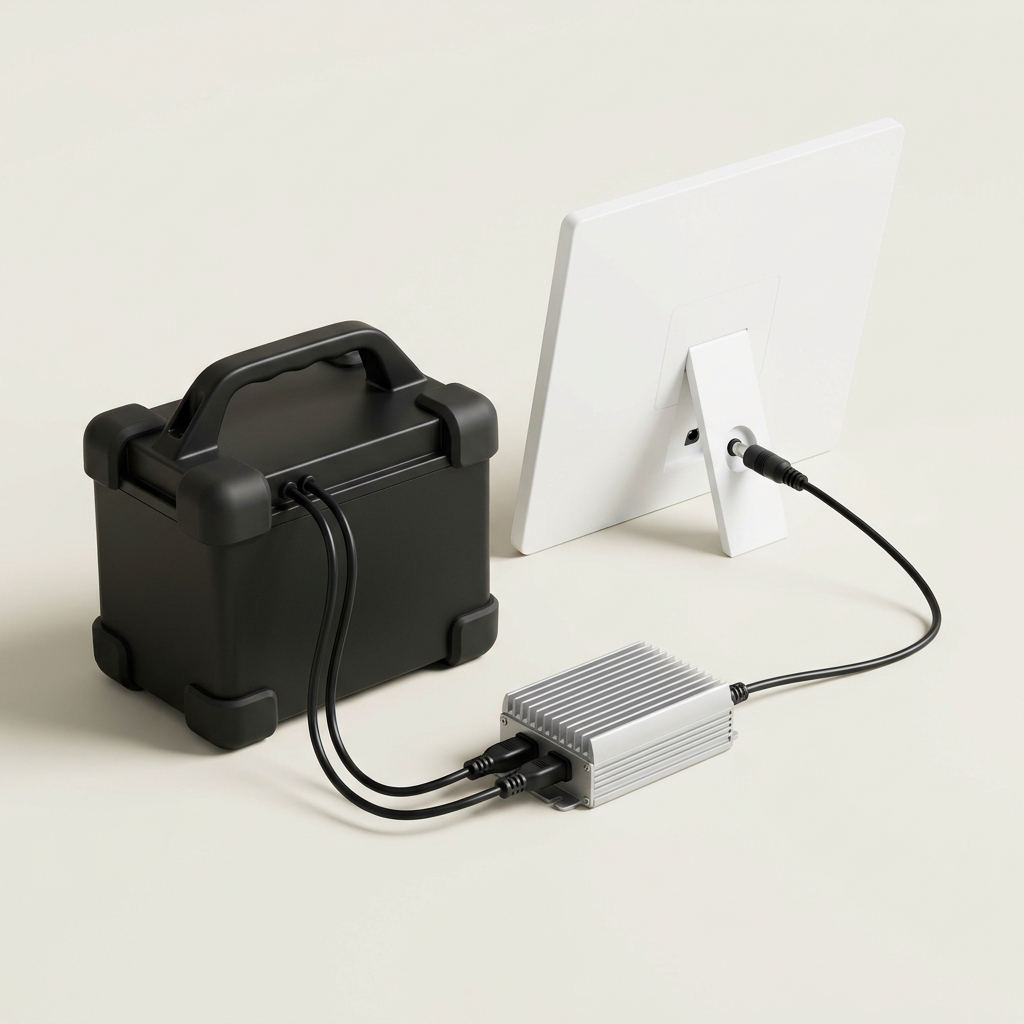
Illustration of a compact white Starlink Mini dish connected to a portable power bank
5.5×2.1mm Waterproof DC Barrel · 25–40W Avg / 60W Peak Editorial illustration

Check your battery setup

Instant · deterministic math
1 Your battery pack
Try a size:
2 Your connection path & dish load

SMALL DETAILS · FEWER SURPRISES

The specs that catch Starlink Mini owners out

Why a 65W laptop bank fails, and why the 49.2 ft cable reboots on 12V.

20V ⎓ 5A (100W)

USB-C PD Handshake

Official USB-C cable demands a 20V/5A contract. 65W (3.25A) ports trip over-current.

11.9V Floor

DC Cable Sag Cutoff

When 12V wiring drops below ~11.9V at the dish under a 60W spike, Mini reboots.

<= 100 Wh

FAA Carry-On Limit

TSA checks rated Wh (mAh × 3.7V ÷ 1000), not wattage.

12V

Using the 49.2 ft stock cable on 12V?

At 60W peak, 49.2 ft of 16 AWG drops 1.85V—pulling a 12.8V battery down to 10.95V.

↗
5.5

5.5×2.1mm vs. 5.5×2.5mm barrel plugs

A 2.5mm inner pin fits loosely on Starlink's 2.1mm center pin, causing heat and resets.

↗
3.7×

Mini vs. Standard Gen 3 off-grid draw

Built-in Wi-Fi and native DC cut daily watt-hours from ~1,000 Wh to ~260 Wh.

↗
FAA

Flying with two 99Wh power banks

How to pack ~198 Wh of approval-free carry-on energy under 49 CFR 175.10.

↗

ELECTRICAL ARCHITECTURE EXPLORER

Where your watt-hours actually go

Tap each power delivery path below to compare conversion efficiency, inverter standby tare loss, and real battery draw at a 35W active dish load:

Path A · Direct 12–48V DC (or 12V→24V/30V Step-Up) 93% Efficiency · 0W Tare
SOURCE BANK Battery Wh 12.8V / 20V PD 85% Usable DoD 7.5A–10A Fuse CONVERSION STAGE 12V→24V/30V Boost 93% DC-DC · 0W Idle 5.5×2.1mm Barrel Keep >= 12.0V TERMINAL LOAD Starlink Mini 12–48V DC Input 25–40W Avg / 60W
37.6 W from battery (at 35W dish load)

Highest efficiency. Feeding 24V or 30V DC via a step-up converter cuts cable current in half and eliminates 12V voltage-drop boot loops over 15–50 ft runs.

SOURCE-CHECKED COMPATIBILITY LEDGER

Verified Power Banks, Stations, Converters & Cables

Filter common off-grid power sources and cables by category. Open full database page ↗

13 of 13 entries shown
Hardware / Topology Profile Published Electrical Spec Est. Runtime (35W) FAA Carry-On Mini Status
99.2Wh / 27,650mAh 140W PD 3.1 Power Bank
Sustains full 20V/5A (100W) handshake on a single port; fits under the 100Wh FAA carry-on ceiling without airline approval.
99.2 Wh · Single-port 100W/140W USB-C PD (20V/5A) 2h 08m ALLOWED (<=100Wh) VERIFIED PASS
88.8Wh / 24,000mAh 100W USB-C PD Pack
Compact carry-on backup; pair two packs (177.6Wh total across 2 units) for ~3.8 hours of remote flight/layover work.
88.8 Wh · 20V/5A PD out · 65W PD in 1h 54m ALLOWED (<=100Wh) VERIFIED PASS
65W Laptop Power Bank (20,000mAh / 74Wh)
Fails official Starlink USB-C cable 100W (20V/5A) requirement; trips over-current shutoff during 55–60W boot/transmit spikes.
74 Wh · Max 65W (20V/3.25A) USB-C output Boot Fail / Trips OCP ALLOWED (<=100Wh) INCOMPATIBLE
145Wh High-Capacity Airline-Approval Pack
Electrically compatible (20V/5A), but falls in the 101–160Wh band requiring explicit airline approval (max 2 spare packs).
145 Wh · 100W USB-C PD (20V/5A) 3h 07m APPROVAL (101–160Wh) CONDITIONAL
256Wh LiFePO4 Portable Power Station (100W USB-C)
Ideal half-day field station. Use the 100W USB-C PD port (20V) rather than the 120V AC inverter to gain +1.9 hours of runtime.
256 Wh LFP · 100W USB-C PD + 12.8V 10A DC 5h 30m (PD) / 5h 49m (DC) GROUND ONLY (>160Wh) VERIFIED PASS
512Wh LiFePO4 Portable Station
Covers a full 8–10 hour remote workday on a single charge when run on DC or 100W USB-C PD with AC inverter turned off.
512 Wh LFP · 100W USB-C PD + 12.6V Car Socket 11h 00m (PD) / 7h 40m (AC) GROUND ONLY (>160Wh) VERIFIED PASS
1,024Wh (1kWh) LiFePO4 Basecamp Station
Full weekend autonomy; pairs with a 200W folding solar panel for indefinite off-grid operation.
1,024 Wh LFP · 2× 100W USB-C PD + 12V/10A DC 22h 00m (PD) / 23h 18m (DC) GROUND ONLY (>160Wh) VERIFIED PASS
100Ah 12.8V LiFePO4 Deep-Cycle House Battery
Standard RV/van auxiliary bank. Add a 12V→24V/30V step-up converter near the battery if cable length exceeds 15 ft.
1,280 Wh LFP · 12.8V Nominal (100A BMS) 28h 55m (with 24V Boost) GROUND ONLY (>160Wh) VERIFIED PASS
12V-to-24V / 30V 5A (120W–150W) Waterproof Boost Converter
Gold-standard fix for RV/marine/overland 12V systems. Eliminates voltage-drop reboots across 30–50 ft cables.
Input 9–18V DC → Output 24V or 30V DC (IP68) 93% Conversion Efficiency N/A (Component) VERIFIED PASS
Unregulated 12V Cigarette Lighter Socket (Direct)
Works with engine running (13.8V) and short (<15ft) 14/16 AWG cable, but frequently sags below 11.9V on resting 12V batteries with the 49.2ft cable.
11.8–14.2V DC · 10A Fuse · High contact resistance Sag Risk > 15 ft cable N/A (Vehicle Port) CONDITIONAL
Official Starlink 5m (16.4 ft) USB-C to Barrel Cable
Designed by SpaceX with weatherproof barrel gasket and 20V/5A PD negotiation. Requires a 100W USB-C PD source.
20V / 5A (100W PD trigger) · Waterproof 5.5×2.1mm barrel Low line loss at 20V N/A (Cable) VERIFIED PASS
Official Starlink 15m (49.2 ft) DC Power Cable
Engineered for the 30V stock AC brick. When fed from an unregulated 12.0–12.8V battery, the 49.2ft run drops >1.1V at 60W peak—causing boot loops.
49.2 ft (15m) · Waterproof 5.5×2.1mm barrel Requires >=20V for full length N/A (Cable) CONDITIONAL
5.5×2.5mm Generic DC Barrel Cable (Wrong Inner Pin)
Physically plugs in but makes loose contact on the 2.1mm center pin, causing arcing, connector heating, and sudden disconnects.
2.5mm ID vs Starlink 2.1mm ID center pin Intermittent / Overheating N/A (Cable) INCOMPATIBLE

Useful answers, with receipts.

Published Starlink 12–48V DC & 100W PD specs · ABYC copper AWG tables · FAA 49 CFR 175.10.

How we calculate & verify →

COMMON QUESTIONS

Frequently Asked Questions

How long does a 99Wh airline power bank run Starlink Mini?

At 25W–35W typical draw over a 100W USB-C PD path (~88% efficiency, ~84Wh usable from a lithium pack), a single 99Wh carry-on battery runs Starlink Mini for 2 hours 07 minutes to 2 hours 55 minutes.

Why does Starlink Mini reboot on a 12V car socket or long DC cable?

Starlink Mini is rated for 12–48V DC (60W peak). On a resting 12.0–12.8V battery, voltage drop across thin or long cables (including the 49.2 ft stock cable) pulls dish terminal voltage below ~11.9V during 55–60W startup or transmit bursts. A 12V-to-24V/30V step-up converter cures this.

Can a 65W USB-C laptop power bank run Starlink Mini?

No. Starlink’s official USB-C to Barrel cable requires a 100W (20V / 5A) USB-C PD source and a 5A e-marker cable. Most 65W (20V/3.25A) ports either refuse the PD handshake or trip over-current protection during boot.

What is the FAA carry-on battery limit for flying with Starlink Mini?

Under FAA / PHMSA 49 CFR 175.10, lithium-ion batteries <= 100 Wh are allowed in carry-on baggage without airline approval. Batteries from 101–160 Wh require airline approval and are limited to 2 spare packs.